

Most AI companies have near-identical websites. The dark theme with gradient colours, sans-serif fonts like Inter and Roboto, the Bento grid layout, and strikingly similar and bland copy on how they are research labs pushing the frontiers of human intelligence.
When I stumbled upon Surge AI’s website last week, I was pleasantly surprised. The copy was different. It didn’t talk about scaling laws or pushing frontiers. It asked when AI would give us a Hemingway . A von Neumann. A Kahlo. Work that could stand next to the greats.
Surge’s list spans two very different kinds of greatness.
Von Neumann’s half is the legible one. In mathematics and engineering, there is an external check on every claim. You have verifiable proofs and benchmarks to measure against. These are measures that the models are visibly climbing: gold-medal performance at the International Mathematical Olympiad, top-percentile finishes in competitive programming etc. Whether AI gets to von Neumann-level competence is a question of when, and not if.
Kahlo and Hemingway sit in the other half. There is no compiler for a painting or prose. A novel can’t be verified. Art is extremely subjective. We do have a visceral way to recognise good art, even though we can’t codify it.
This raised two pertinent questions in my mind.
For AI to produce art that is extraordinary, what conditions need to be satisfied?
Why are today’s AI outputs reasonably far-off from being remembered as great pieces of art?
What makes great art discernible?
The best answer I found is over a century old. In 1917, the Russian critic Viktor Shklovsky wrote an essay called “Art as Technique” that starts from an observation about everyday perception: it is familiar.
We don’t have to finish our sentences for meaning to come out. We eat words. We stop seeing the things we live with. Shklovsky describes cleaning his room and being unable to remember whether he had dusted the divan. I thought I was the only one who had such brain fade moments but it happens because the movement is so habitual that it leaves no trace of having happened.
“Habitualization devours work, clothes, furniture, one’s wife, and the fear of war… And art exists that one may recover the sensation of life; it exists to make one feel things, to make the stone stony. The purpose of art is to impart the sensation of things as they are perceived and not as they are known.”
Artists are great at redefining trivial things from unique perspectives. He uses the term “defamiliarisation” to point to this technique and illustrates how greats like Tolstoy heavily deployed it throughout their work.
For simplicity, let’s call this characteristic “surprise”.
Good art surprises. It hands you something that you didn’t expect, yet it seems inevitable when you stay with it. So the violation doesn’t seem out of place, but reads as rightness you hadn’t known to want.
Camus, the French/Algerian philosopher, starts his seminal novel “The Stranger” with:
“Mother died today. Or maybe yesterday; I can’t be sure.”
The sentence violates the most basic expectation we have of grief—that a son would at least know the day. In one line Camus makes every familiar ritual around death, justice, and feeling look like a performance we had stopped noticing we were giving. He carries the sentiment wonderfully throughout the book to show the absurdities of life.
One of my favourite descriptions of love is Jigar Moradabadi’s couplet:
“Ye ishq nahin aasaan, itna hi samajh leeje / Ik aag ka dariya hai, aur doob ke jaana hai”
(“This love is not easy, understand just this much: it is a river of fire, and one must drown to cross it.”)
The surprise here comes in two degrees.
Love is usually imagined as a journey, and a river on the way is a familiar obstacle. Jigar keeps the river but fills it with fire. That is the first surprise.
Then he compounds it. A river is crossed by swimming, and the metaphor sets you up for exactly that word. Jigar writes doob ke: you cross this river by drowning in it.
If you let the lines simmer in your mind, the inevitability lands. The doob ke stops feeling like a flourish and starts feeling like the only word that could sit there. Anyone who has been through love knows this is how it works. You don’t get across intact.
Painters do it too. A night sky is the calmest subject in art, and Van Gogh fills his with violent churn. The Starry Night swirls like water about to boil. The strange part is that the turbulent version feels more true to standing under a vast night sky than any photograph does. The expectation is broken in exactly the direction of the experience.
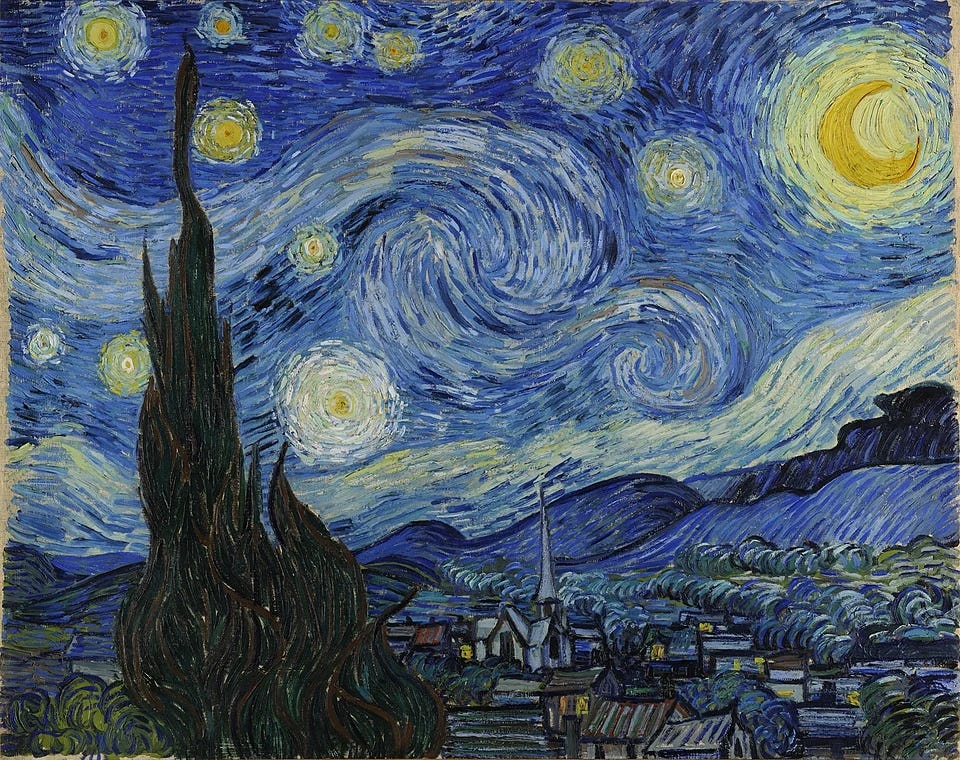
The element of surprise exists across multiple dimensions in great pieces of art—from words and sentences, to colours, melody and cinematography. As we consume great art, these subtle surprises create a kind of inquisitive unease—pushing us to discern the piece and drift away from the mundane of everyday perception.
But surprise alone can’t make great art. If creators just focus on optimising strangeness for the sake of it, we will end up with inherently meaningless and nonsensical creations.
The surprises need to be coherently bound together. They need to build towards something. They need to make subtle reappearances at different instances. They should exhibit a pattern!
Aristotle theorised narrative art in the book Poetics. Of coherence, he says the following:
One event should cause the next, not merely follow it. A good test for a plot is whether each turn happens by necessity or probability rather than by accident. String a set of incidents together in time and you have a chronicle; make each one grow out of the last and you have a plot. The difference is causation, not chronology.
If you can remove it, it was never part of it. Take out any piece and the thing should break. If it doesn’t, the piece was decoration. Most of coherence is deciding what to leave out.
Poems and long form fiction are coherent by virtue of their core characteristics. Whether it be stanzas talking to each other or the subtle unravelling of the plot, the sum is greater than the parts.
Sometimes coherence hides in the structure. Sometimes you can see it plainly; and when you can, it sharpens the surprise instead of muting it.
Let’s consider the Taj Mahal. It is an epitome of beauty and consequently an example of great art.
A tomb is usually the most sombre building type there is, and the Taj is the opposite of sombre. It’s radiant, symmetrical, almost weightless-looking white marble, built for a corpse. The expectation is that grief this permanent should look heavy; instead it looks like the lightest thing ever built.
Symmetry runs through the entire architecture—the four minarets framing the dome, the charbagh garden quartered and then quartered again, and the mosque on the west answered by an identical building on the east that serves no function except to preserve the mirror and offer rhythm.
The Mahabharata runs the same trick through Karna. It plants his secret early as Kunti’s abandoned firstborn, born before her marriage, set adrift on a river and raised by a charioteer, scorned as low-born his whole life for it. That one withheld fact detonates at the climax: Krishna offers him the throne to switch sides, his own mother begs him to spare her other sons, and he refuses both, choosing the loyalty that will get him killed. The buried identity, planted at the start and paid off at the end, quietly reframes every insult he ever swallowed.
Beyond elements of surprise and coherence, great works of art refuse to deplete. They have multiple layers of depth. They hold back. And they refuse to tell you something.
Frost engineered this depth into four lines. His most popular work “Stopping by Woods on a Snowy Evening” ends with:
“The woods are lovely, dark and deep,
But I have promises to keep,
And miles to go before I sleep,
And miles to go before I sleep.”
The first utterance is literal. It talks about a tired man, a long ride home. The second turns metaphorical and deathward; it signals life’s obligations. It leaves you unsettled.
Hemingway in fact encapsulated this nuance around depth and layers through his iceberg theory. It states that a writer should only reveal a small portion of the story explicitly, whereas the bulk of the meaning and emotion should be implied or hinted at.
Great art has scope for interpretation. Artists pour their souls into their work. This soul is a consequence of their cumulative experiences. That carries a lot of the weight and this is what makes great art durable. The Mona Lisa amazes you on your thousandth viewing as well. Beethoven’s symphonies pull you in even if you are nonchalantly listening as a non-music connoisseur. Nolan’s movies make you marvel on every rewatch.
But it is not just the artist’s soul that does all the work here. The consumer of the art also brings in a perspective. They have their own unique experiences. They relate to the art in widely distinctive ways. They find their own meaning.
Once produced with the above-mentioned characteristics, great art (most but not all) typically grows in stature due to the following factors:
The stories of the art/artists - the Mona Lisa was stolen; Viktor Frankl survived the Holocaust; and Dostoevsky’s prison stint has a huge bearing on his novels.
Cultural saturation - some pieces of great art follow the power law where due to their cultural integration and repeated references, they continue to become bigger and bigger with time.
Institutional backing - being crowned as one of the seven wonders of the world elevates the standing of the Taj Mahal or being housed in the Sistine Chapel makes Michelangelo’s Creation of Adam an iconic painting.
However, popularity should not be conflated with the characteristic greatness of the art piece. The only reason to bring this up was to make a case for why AI generated art doesn’t last. I will come back to this later.
Why aren’t AI models creating great art?
I believe AI artefacts diverge from what we would consider great art at three levels—process, output and identity.
Process
When an artist creates art, they either chase a directional vision or gradually define amorphous states over multiple iterations. It is built bottom-up.
Even when there’s an end goal, there is creative flexibility to alter direction, to expand and move about. The target and the artefact co-evolve. You don’t actually know what you want at the start; each iteration refines both the work and your understanding of what you were trying to make. Every increment of feedback, whether from a collaborator or your own disposition, moves the work where you want it to move, because you travel with it.
The AI workflow inverts this. The vision gets frozen into a prompt, and the model samples. The first draft lands arbitrarily in space. A vague prompt maps to a huge region of possibility, and the model fills the gaps with its statistical average, which is usually far from what you had in your head. Worse, iteration doesn’t converge. Ask a designer for “the same face, but looking left” and they change one thing and preserve everything you didn’t mention. Ask a diffusion model and you often get a different face. Each generation is a fresh, memoryless draw. You want refinement; you get variance. It’s hit or miss.
Hence, the AI models find it hard to bake in surprise at the right layers, be coherent overall and add depth across the volume of work.
Output
A generative model is trained to predict the expected thing. A language model emits the high-probability continuation; a diffusion model settles toward the centre of its training distribution. Set that against characteristic one (surprise) and the conflict is structural: we built a machine optimised for the familiar and asked it to do defamiliarisation. The mean of everything is bland.
It also explains the texture of the failure: AI output is strong at the surface (locally gorgeous sentences, competently lit images) and weak at long-range structure. The details are individually pretty but don’t accrue meaning, which is exactly why coherence and depth requirements are unmet.
Identity
The longevity of great art relies on a critical anchor that AI-generated art inherently lacks: a distinct human identity. Our fascination with the human crucible of creation does a lot of work in adding weight to the work.
Without a characteristic author to ground the work, AI art cannot genuinely integrate into our cultural fabric or command deep institutional backing; instead, it achieves only fleeting popularity as a technical novelty.
It would be a mistake to treat this as a permanent verdict, and there are counterarguments to the above-mentioned thesis.
In blind tests, people sometimes rate AI images and poems higher than human ones, until they’re told which is which. Part of what reads as bad is a status reaction to knowing it’s AI, amplified by the flood of slop output across the internet. Photography drew the exact same objections when it first gained popularity. It was termed mechanical, soulless, and not considered a real art. That judgement aged badly.
Surge’s copy asks when we’ll get our machine Hemingway, our machine Kahlo. My hypothesis: the models will close the gaps on process and output. They’ll learn to place surprise at the right layers, hold a work coherent, and leave depth unsaid. Every current gap that I’ve named is mechanical rather than metaphysical: invariant-preserving edits are a tractable engineering problem, persistent state is an architecture question, and active elicitation is something models are beginning to do. Betting against engineering gaps has been a losing trade for a decade.
I believe that the last gap isn’t an engineering one. The weight that great art carries is the residue of a life actually the artists lived, and I am not entirely sure how and when we can hand AI a life to leave a residue of.